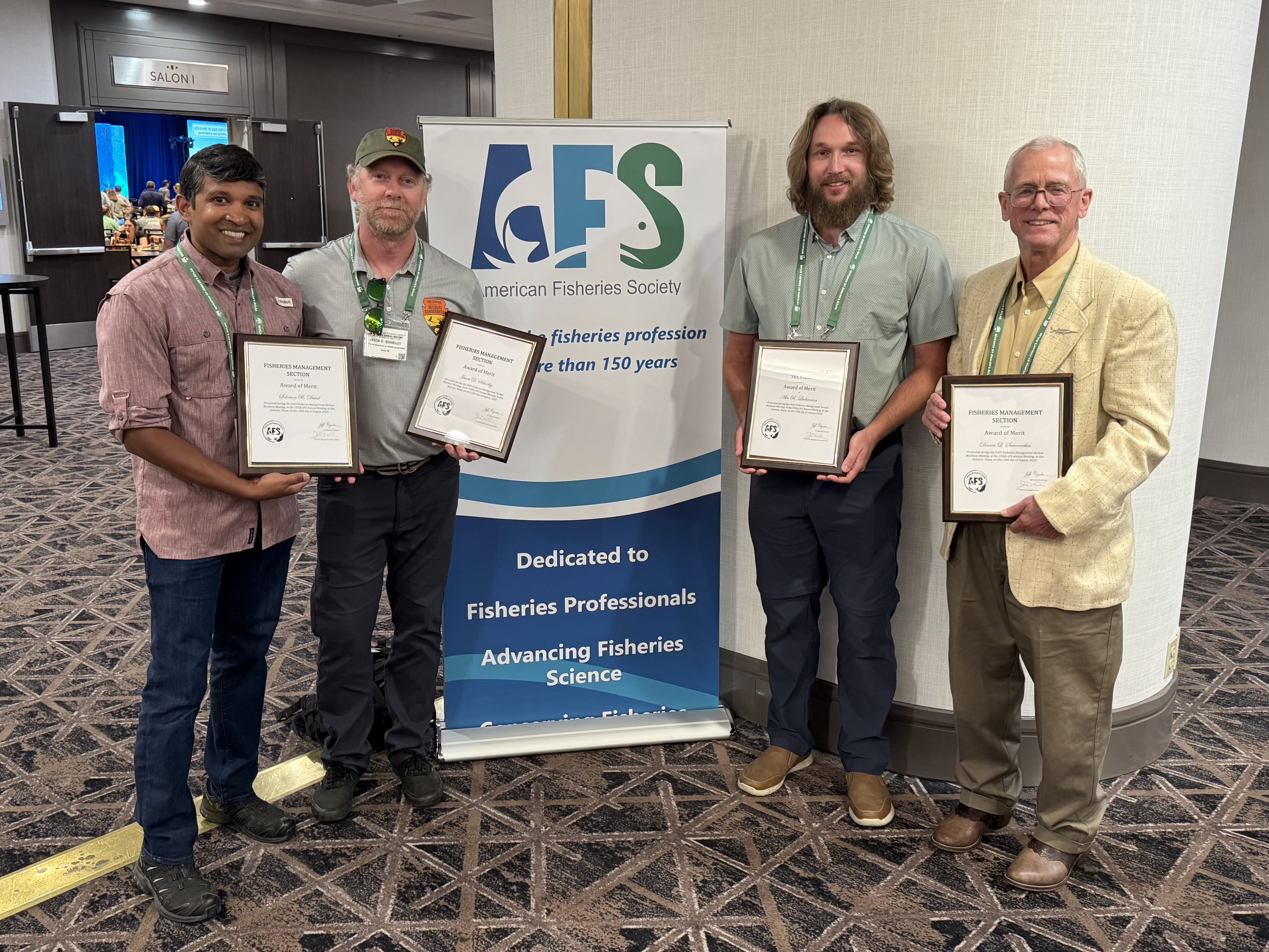
Solomon David (far left), Jason Schooley (second from left), Alec Lackmann (second from right), and Dennis Scarnecchia (far right) stand with their awards.
Solomon David, assistant professor in the College of Food, Agricultural and Natural Resource Sciences (CFANS) on the Twin Cities campus, and Alec Lackmann, a fisheries biologist in the Swenson College of Science and Engineering on the Duluth campus and researcher in CFANS, were awarded the 2025 Award of Merit for the Fisheries Management Section of the American Fisheries Society for their collective and continued efforts to advance the understanding, appreciation, conservation, and management of native nongame fishes in the US.
Both have also recently received multi-year grants as principal investigators, studying these underappreciated fish species once outcast as “rough fish”. LINK
It’s a big week for Dr. Solomon David and the GarLab at the University of Minnesota: Dec. 16-20 is the third annual Gar Week. It’s a seven-day celebration of some of the strangest fish to ever swim, those of the Lepisosteidae family. For David, a scientist and assistant professor, and the students in his lab on the St. Paul campus, Gar Week is when they get to unleash their enthusiasm for these misunderstood fish across America and social media. CONTINUE READING
The Department of Fisheries, Wildlife, and Conservation Biology is excited to welcome Dr. Solomon David! Dr. David is an aquatic ecologist and assistant professor of biological sciences interested in fish biodiversity, conservation, and science communication. His current research focuses on the ecology of migratory and ancient fishes, and how that research can help us better understand and conserve aquatic ecosystems.
His team also communicates science through traditional and social media to raise awareness of the value of aquatic ecosystems and freshwater biodiversity. Follow their projects at #GarLab
Dr. David joined FWCB in early August as an Assistant Professor!
THIBODAUX, La. — Nicholls State University will lead the observation and conservation of alligator gar and other Louisiana fish species for a $400,000 project that aims to improve connections between the Mississippi River and a north Louisiana floodplain.
The National Fish and Wildlife Foundation (NFWF) awarded the $400,000 grant to Nicholls, the Louisiana Universities Marine Consortium (LUMCON), and the Lower Mississippi River Conservation Committee (LMRCC). The Louisiana Department of Wildlife and Fisheries (LDWF) will also partner on the project.
The goal of the project is to improve connections between the Richard K. Yancey Wildlife Management Area floodplain and the Mississippi River. LMRCC will improve three culverts and a weir to enhance the connection. LDWF will work on monitoring sport fish and water quality impacts, facilitate public outreach, and support the research teams.
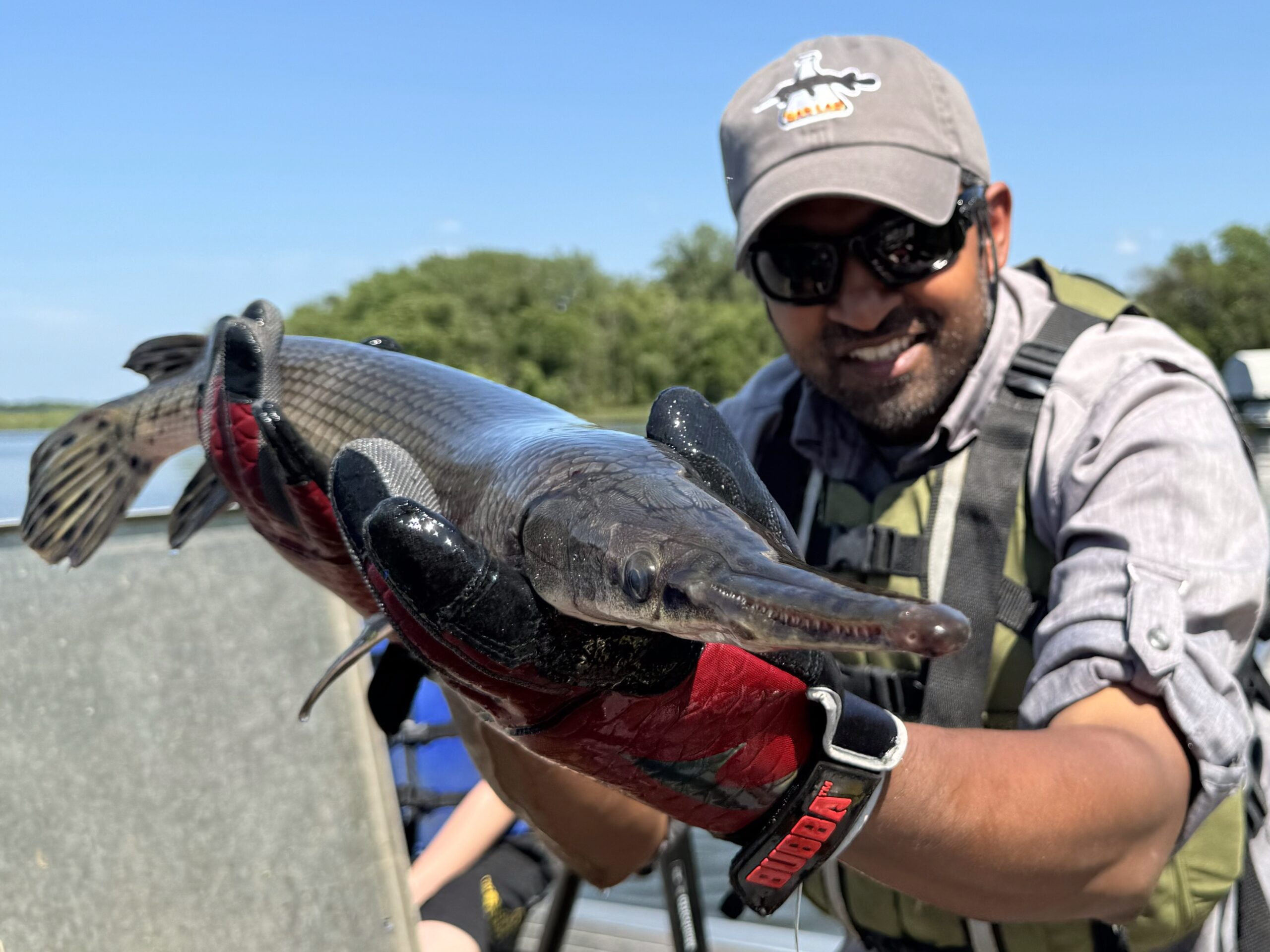
Assistant Professor of Biological Sciences Dr. Solomon David and his students will partner with LUMCON to monitor the alligator gar. Dr. David is an internationally recognized expert in garfish and principal investigator of the GarLab.
“We are excited to work with this talented team of professionals and provide Nicholls students research opportunities to study these amazing fishes,” said Dr. David. “Fishes are among the best indicators of aquatic ecosystem health, and we’ll be looking to Louisiana’s largest freshwater fish to help determine restoration and conservation success.”
Dr. David and his students will monitor how the project affects the local fish populations and habitat. The information gathered will be used to guide future projects.
“We’re looking at how the Mississippi River floodplain restoration, specifically improving connectivity between the river and the floodplain, benefits wildlife,” Dr. David said. “Alongside the alligator gar, we’ll also be monitoring size, number and habitat use of other fish species to get a better picture of how habitat improvements benefit these valuable freshwater ecosystems.”
The project is one of four awarded by NFWF through the Lower Mississippi Alluvial Valley Restoration Fund. Launched in 2017, the LMAV Fund is a competitive grant program that supports restoration, enhancement and management of bottomland hardwood forests and wetlands, and promotes aquatic connectivity on private and public lands. The program is a partnership between NFWF and the U.S. Department of Agriculture’s Natural Resources Conservation Service and U.S. Fish and Wildlife Service, with private funding from International Paper’s Forestland Stewards Partnership and the Walton Family Foundation.
Each project will support the preservation of the nation’s largest floodplain. At more than 24 million acres, the valley stretches from Illinois to Louisiana, including the Atchafalaya Basin and Houma-Thibodaux region.
FOR IMMEDIATE RELEASE: Aug. 31, 2020
MEDIA CONTACT: Jacob Batte, Media Relations and Publications Coordinator, 985.448.4141 or jacob.batte@nicholls.edu
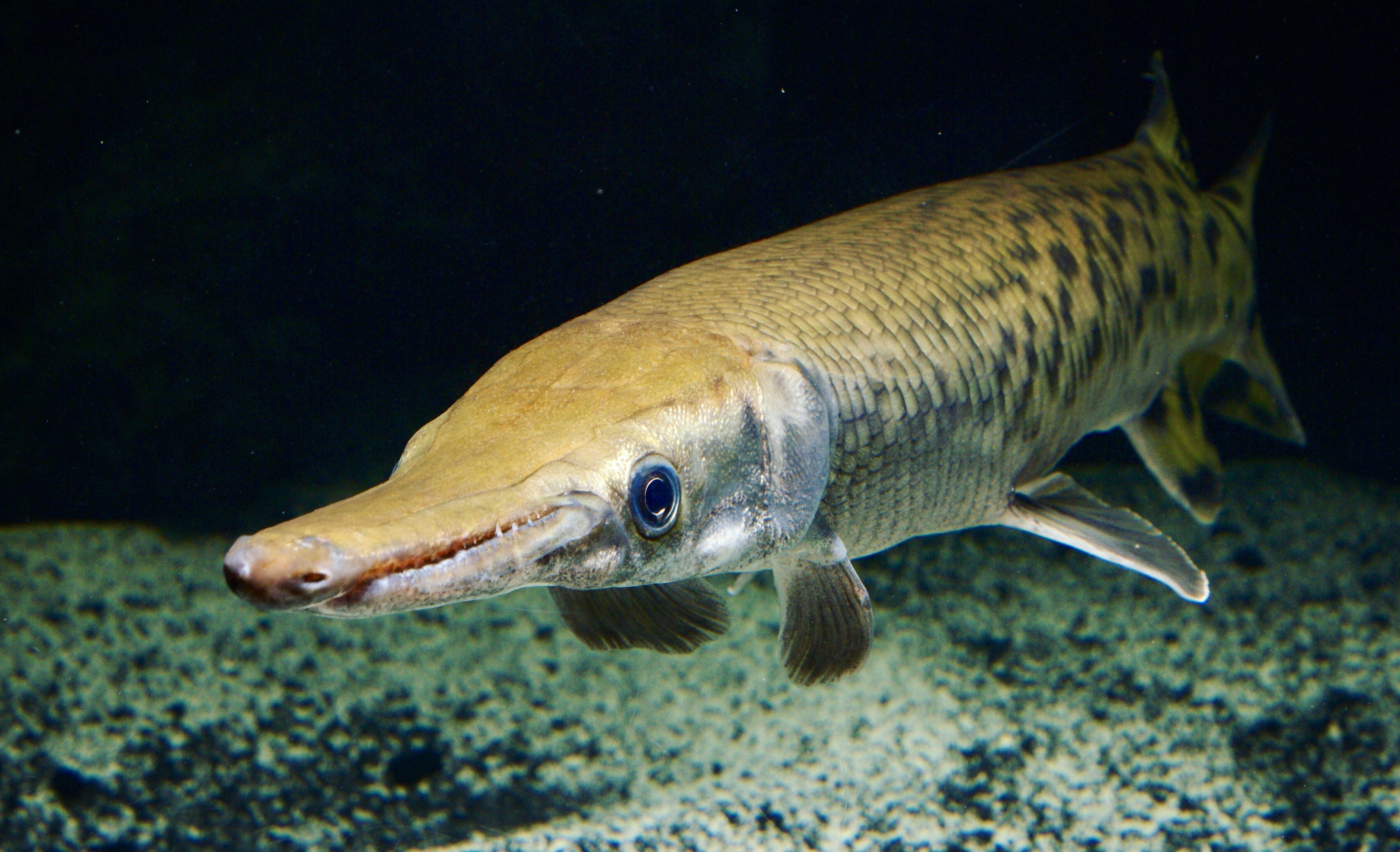
Spotted Gar and Bigmouth Buffalo from Louisiana bayou collected by ichthyology students at Nicholls State University.
Note: The opinions expressed in this post are those of the author, and do not necessarily represent those of the entire Fisheries Blog team.
Cover Image: Bigmouth Buffalo from Louisiana bayou collected by Nicholls State University graduate student Sarah Fontana.
Many of you have heard the terms rough fish, non-game fish, coarse fish…trash fish. What fishes are these terms referring to? They can vary regionally, but it’s usually a species that particular angler doesn’t want to catch. These fishes aren’t your Largemouth Bass, Rainbow Trout, or Chinook Salmon; more often they are suckers, gars, bowfins, and drum. Historically less popular, members of the latter group are still important components of their native ecosystems, and contribute to biodiversity! Some of the so-called “trash fish” group help maintain ecosystem…
Alligator Gars have been in the media quite a bit recently, primarily regarding their potential as a “weapon against Asian Carp.” But is carp control really the purpose of their reintroduction in several states, most recently in Illinois? Even if that were the case, would these ancient giants make a difference versus the gargantuan numbers of Bighead and Silver Carps?
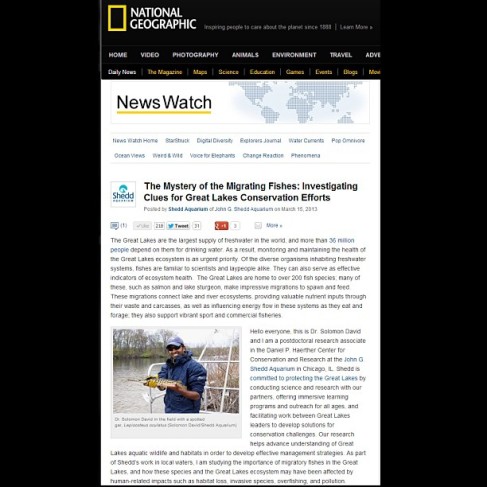
Many apologies for the lack of updates over the past many months, the transition from University of Michigan (Ann Arbor) to my postdoc at Shedd Aquarium (Chicago)/University of Wisconsin (Madison) kept me quite busy to say the least! I will try to update more consistently, but for now, please see the following image/link to an overview of some of our Great Lakes migratory fishes work at Shedd Aquarium/U-Wisconsin Madison which will be featured in blog updates for National Geographic! More field pics to come from my current field work here in Green Bay, WI (tracking migratory northern pike Esox lucius)!–



 GarLab - Solomon R. David, PhD